

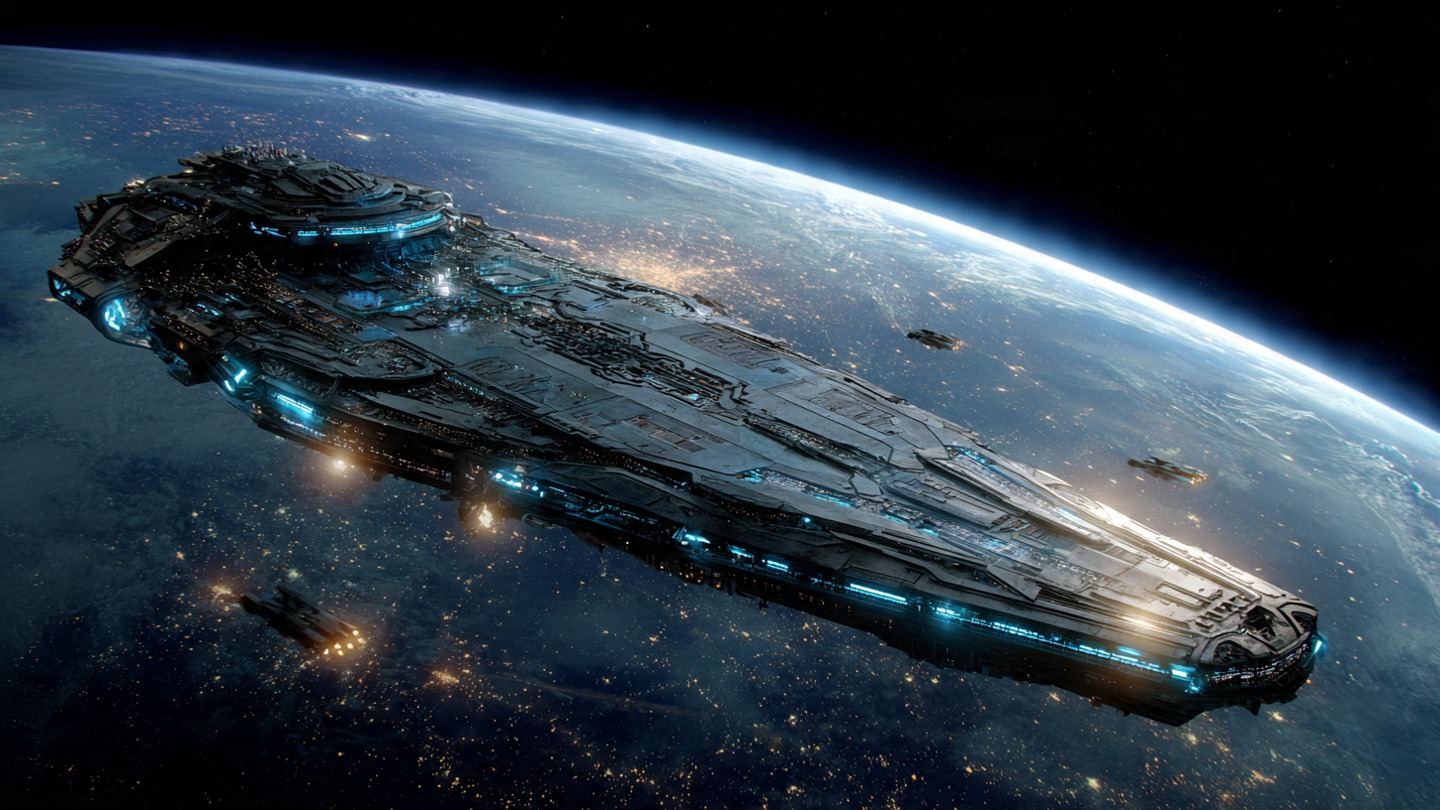
Space Force Orbital Warship Carrier: Science Fiction or the Next Military Evolution?
The idea of a space force orbital warship carrier sounds like something pulled straight from a late-night sci-fi marathon. A massive spacecraft. Docking bays filled with smaller combat vehicles. Defensive systems scanning Earth’s orbit. Silent. Waiting.
But here’s the thing space has already become a strategic battlefield.
Not with lasers and dramatic explosions (at least not yet), but with satellites, cyber systems, GPS networks, and surveillance platforms that quietly shape everyday life. Your Google Maps route? Satellite-dependent. Banking timestamps? Satellite. Weather forecasting? Same story.
So when people talk about an orbital warship carrier, they’re not just fantasizing. They’re reacting to a real shift in global defense thinking.
Let’s unpack this properly.
Why Space Is No Longer Just for Astronauts
A few decades ago, space exploration felt almost poetic. Moon landings. Telescopes. Scientific discovery.
Now? It’s infrastructure.
Military strategists across the world recognize that whoever controls orbital space holds enormous strategic leverage. Disrupt satellites and you disrupt communications, intelligence, navigation, and missile defense systems.
The U.S. officially created the Space Force in 2019. That move alone signaled something important: space is now treated as a warfighting domain alongside land, sea, air, and cyber.
If you look at official doctrine from organizations like U.S. Space Force, the emphasis is on protecting satellites and ensuring “freedom of operation in space.” That’s carefully worded. But it hints at something bigger.
Protection eventually requires platforms.
And platforms evolve.
What Exactly Is a Space Force Orbital Warship Carrier?
Let’s simplify it.
Think of an aircraft carrier at sea.
It’s not just a ship. It’s a mobile base. It launches aircraft. Repairs them. Refuels them. Acts as command central.
Now move that concept into orbit.
A space force orbital warship carrier would theoretically be:
- A large orbital platform
- Capable of deploying smaller spacecraft or defensive drones
- Equipped with surveillance and communication systems
- Possibly armed with defensive countermeasures
It wouldn’t necessarily fire laser beams like in movies. At least not initially. Modern military design usually starts with surveillance and defensive capability before offensive escalation.
In reality, early versions would likely look more like:
- A modular orbital station
- Satellite deployment hub
- Space situational awareness center
Less “Star Destroyer.” More “high-tech orbital logistics station.”
But evolution is inevitable.
The Technology Is Closer Than You Think
People assume we’re centuries away from something like this.
We’re not.
Reusable rockets from companies like SpaceX have drastically lowered launch costs. That’s huge. Cheap access to orbit changes everything.
Satellite miniaturization? Also real.
Autonomous drone tech? Already operational.
AI-assisted targeting systems? In development across multiple nations.
Combine these advancements and suddenly an orbital carrier doesn’t feel impossible it feels expensive, but achievable.
And militaries don’t ignore achievable.
How Would an Orbital Carrier Actually Work?
Let’s imagine a realistic, near-future version.
1. Orbital Deployment Hub
The carrier would sit in low Earth orbit (LEO). From there, it could release:
- Defensive microsatellites
- Communication relays
- Inspection drones
These could maneuver toward threats or protect high-value assets.
2. Repair and Refuel Station
One of the biggest problems in space is maintenance. Satellites fail. Fuel runs out.
An orbital carrier could extend the lifespan of critical systems by servicing them. That alone would be strategically powerful.
3. Surveillance Command Center
Modern warfare depends on information. A carrier would likely host advanced sensors to monitor:
- Space debris
- Suspicious satellite maneuvers
- Anti-satellite weapon tests
Information dominance is often more valuable than firepower.
The Strategic Purpose Behind It
Here’s where things get serious.
A space force orbital warship carrier wouldn’t exist just to look intimidating. Its main purposes would likely include:
- Deterrence
- Rapid response capability
- Asset protection
- Strategic dominance in orbit
Deterrence is key. When one nation demonstrates it can protect or disable orbital assets, others think twice before escalating.
This mirrors Cold War naval strategy. Aircraft carriers weren’t always used in battle but their presence alone changed diplomatic calculations.
Orbit may follow the same path.
The Legal Gray Zone
Now let’s slow down.
Space isn’t technically a free-for-all.
The Outer Space Treaty of 1967 prohibits placing nuclear weapons in orbit. It promotes peaceful use of space.
But it doesn’t explicitly ban conventional military infrastructure.
That’s the loophole.
You can’t station nukes in orbit. But surveillance systems? Defensive platforms? Dual-use infrastructure?
That’s a much murkier conversation.
And nations tend to interpret gray zones creatively when strategic advantage is involved.
Would It Spark a Space Arms Race?
Short answer? Possibly.
Long answer? It’s already happening in quieter ways.
Countries are testing anti-satellite capabilities. Satellite “inspection” vehicles are being launched. Space debris events sometimes raise eyebrows.
The difference is scale.
A true orbital carrier would signal a shift from experimental defense to permanent military presence in space.
And once one country does it… others won’t sit still.
History has shown that clearly.
The Engineering Challenges No One Talks About
Let’s be honest. This isn’t easy.
Major hurdles include:
Radiation Exposure
Electronics degrade in orbit due to radiation. Shielding is heavy and expensive.
Orbital Debris
Space junk travels at extreme speeds. Even small fragments can destroy equipment.
Cost
We’re talking billions possibly trillions over decades.
Logistics
Resupply missions. Crew rotations. Autonomous operations.
Even with modern technology, building a fully operational space force orbital warship carrier would be one of the most ambitious engineering projects in history.
Could It Be Autonomous?
Most likely, yes.
Human crews are expensive and vulnerable. AI-driven systems could manage:
- Navigation
- Threat detection
- Docking operations
- Resource allocation
Autonomous defense systems are already being integrated into terrestrial military platforms. Space would follow that trend.
Still, full autonomy raises ethical questions. Machines making defense decisions in orbit? That’s a big conversation.
Is This Pure Science Fiction?
Not entirely.
We don’t currently have a deployed “orbital warship carrier.” There’s no hidden Starfleet base circling Earth.
But conceptually?
The pieces are assembling.
Space militarization isn’t explosive and dramatic. It’s incremental. Quiet upgrades. New doctrines. Budget increases. Infrastructure expansion.
And somewhere along that path, a large orbital military platform becomes less fantasy and more strategic inevitability.
How This Affects Everyday People
You might be wondering why should I care?
Because your daily life depends on space systems.
If orbital assets are threatened, GPS disruptions could affect transportation. Communication blackouts could impact banking and internet services. Weather tracking could degrade.
An orbital carrier designed for defense might actually stabilize space operations.
Or escalate tensions.
It depends on how responsibly it’s deployed.
The Psychological Factor
There’s also something symbolic here.
Humanity placing war platforms above Earth changes perception.
For centuries, conflict was grounded. Then it went airborne. Then cyber.
Orbit feels different. It feels like crossing a line.
But history shows that once a domain becomes strategically useful, it eventually becomes militarized.
Space may simply be next in that pattern.
The Future: What Comes Next?
Will we see a fully operational space force orbital warship carrier in the next decade?
Unlikely.
In the next 30 to 50 years?
Much more plausible.
It may not look like a Hollywood battleship. It may resemble a fortified logistics station with defensive drones.
But functionally? It could operate like a carrier.
The groundwork is being laid now — through budget allocations, technological research, and strategic planning.
The shift won’t be loud.
It’ll be gradual.
And then one day, it’ll feel normal.
FAQs
Is there currently a Space Force orbital warship carrier in orbit?
No. There is no publicly known operational orbital warship carrier. The concept remains theoretical and speculative.
Would it violate international space law?
Not necessarily. Nuclear weapons are banned in orbit, but conventional military infrastructure exists in a legal gray area.
Could other countries build similar platforms?
Yes. If one nation deploys a large orbital defense carrier, others would likely develop comparable systems.
Would it be manned or autonomous?
Most experts believe early versions would be largely autonomous due to cost and safety concerns.
Is this just science fiction hype?
Partially. The name sounds cinematic, but the underlying military strategy of orbital infrastructure is very real.
Final Thoughts
The phrase space force orbital warship carrier triggers imagination. Big ships. Interstellar drama. Laser battles.
Reality is quieter and more strategic.
Space has already become essential infrastructure. Protecting that infrastructure will require increasingly sophisticated platforms.
Whether that becomes an orbital carrier or something more subtle remains to be seen.
But one thing is clear.
Space isn’t just the final frontier anymore.
It’s becoming the next strategic high ground.
